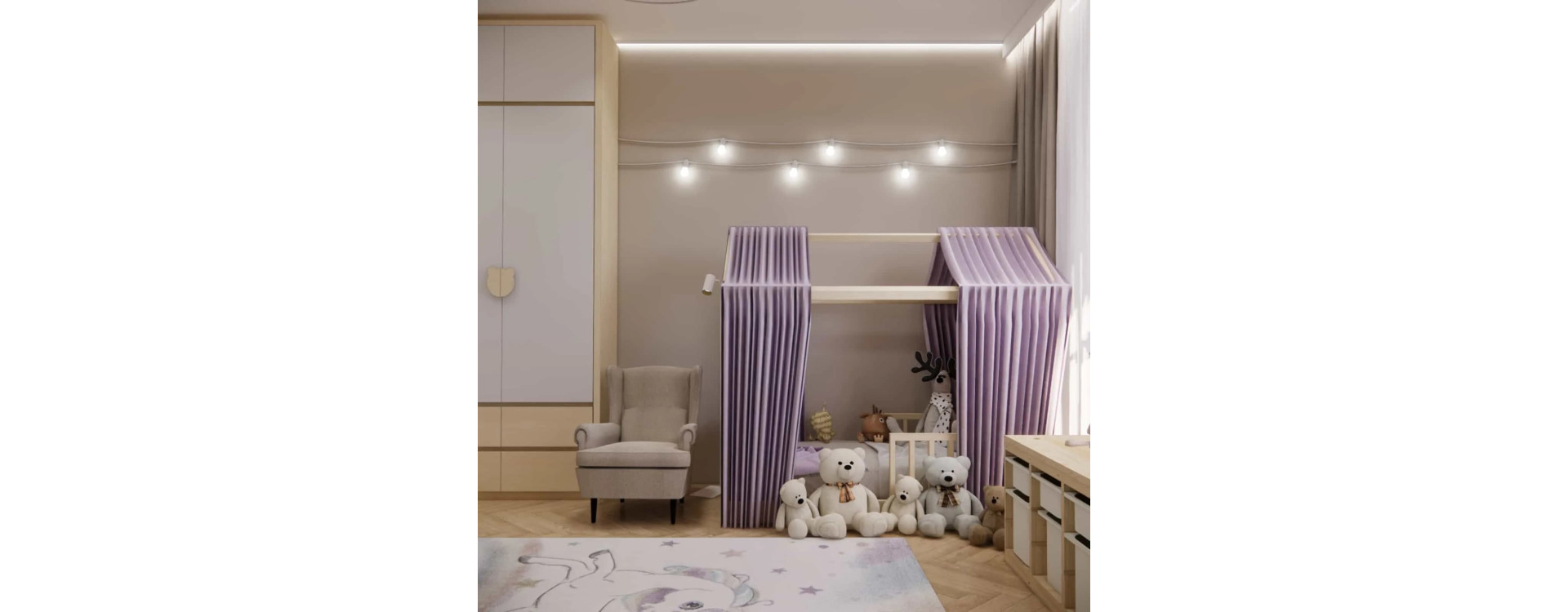
Some projects are created out of a need for aesthetics. And there are also those that begin with a child’s imagination, everyday rituals, and dreams captured in the details. We designed this room for a 4-year-old girl in exactly that way – not as just a “pretty interior,” but as a small world where a child should feel safe, free, and happy.
At the age of four, a room is no longer just a place to sleep. It is a space where a child plays, rests, looks at books, draws, creates their first stories, and learns independence. That is why designing a girl’s room at this age requires a good plan. Simply choosing pretty furniture and decorations is not enough. What is needed is a functional layout, well-thought-out storage, furniture scaled appropriately to the child, and a cohesive aesthetic that will not feel tiring or chaotic.
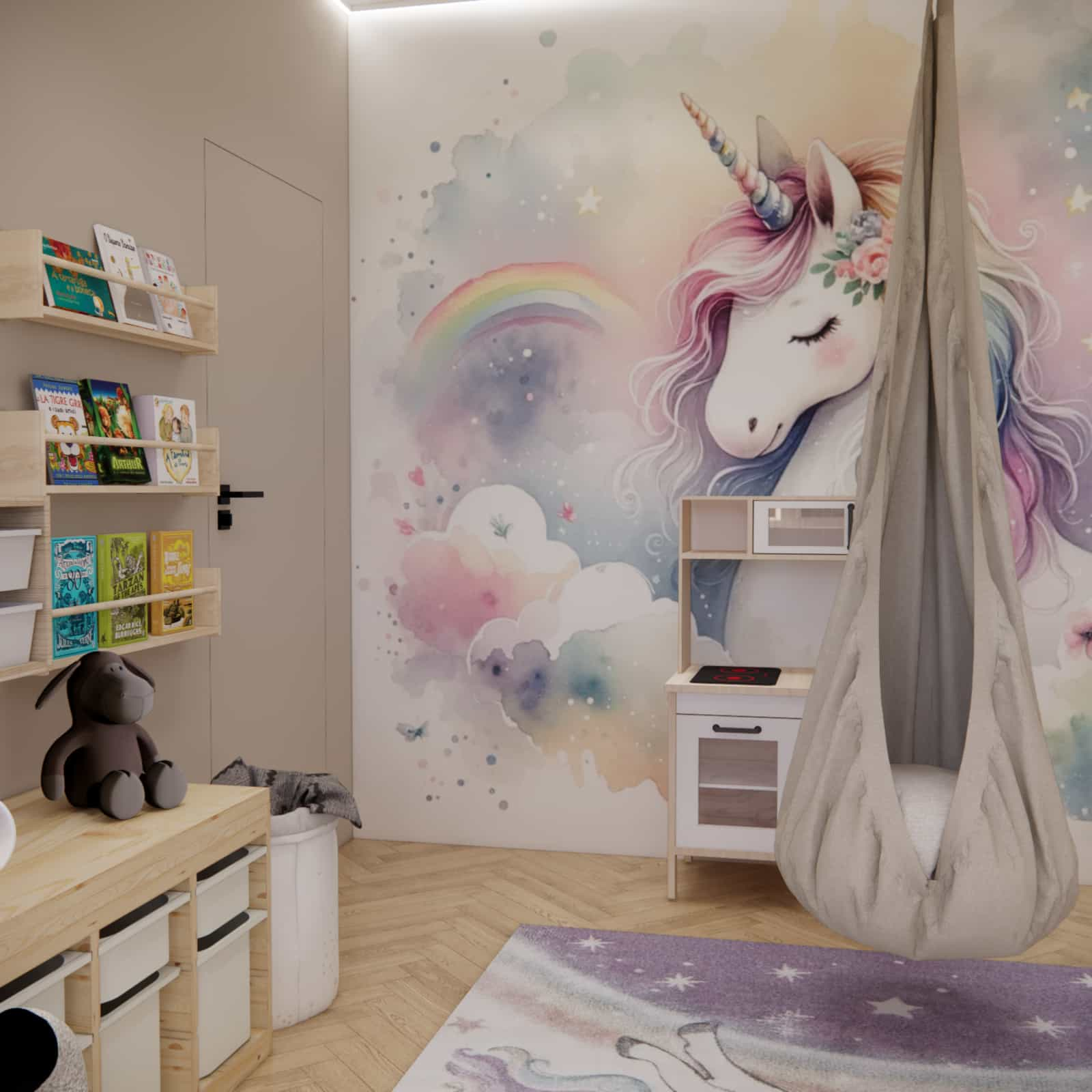
In this project, we chose a pastel interior with a distinct yet subtle fairy-tale theme. The most important element of the composition is the house bed with a canopy, which creates atmosphere, gives a sense of coziness, and naturally defines the sleeping zone. Next to it, we added unicorn wallpaper, an IKEA Trofast storage system with bins, a small desk for creative activities, and a soft rug marking out the play area.
We designed the entire room so that it would not only look charming in the renders, but above all be comfortable in everyday use. This interior is meant to help parents organize the space while also supporting the child in building independence. That is exactly what a well-prepared children’s room design is about – combining aesthetics with real life.
If you are looking for similar designs and want to see more ready-made ideas, also take a look at the category rooms for girls aged 3–7, where we present different arrangements, layouts, and inspirations suited to this stage of a child’s development.
How to design a room for a 4-year-old girl so that it is beautiful and comfortable every day?
This question comes up very often, and it does not surprise us at all. A preschooler’s room has to fulfill several functions at once. It should be a place for sleeping, playing, calming down, storage, and first educational activities. If the interior is arranged randomly, it very quickly becomes visually overwhelming or simply impractical.
At Fabryka Projektów, we always begin by analyzing the lifestyle of the child and the family. We consider what everyday life looks like, how many things need to be stored, whether the child likes playing on the floor, whether they need a place to draw, and how many books, stuffed animals, and toys they have. Only then do we choose specific solutions.
In the case of this interior, the most important thing was to create a room that would feel soft, cheerful, and pleasant, but not overly sweet. We wanted to avoid an excess of random colors and decorations. Instead, we opted for a calm base, one clear leading theme, and elements that genuinely support everyday life.
A well-designed room for a 4-year-old girl should:
- have a clearly defined sleeping area,
- offer a comfortable place for playing on the floor,
- provide easily accessible storage,
- be scaled to the child’s height,
- create a friendly and calm atmosphere.
These are exactly the principles on which we based the entire design.
Zoning – the most important foundation of a children’s room design
One of the most common mistakes in children’s room design is treating the space as one undivided interior into which furniture is simply placed. Meanwhile, a child functions much better in a room with a clear layout that naturally suggests what each part of the space is for.
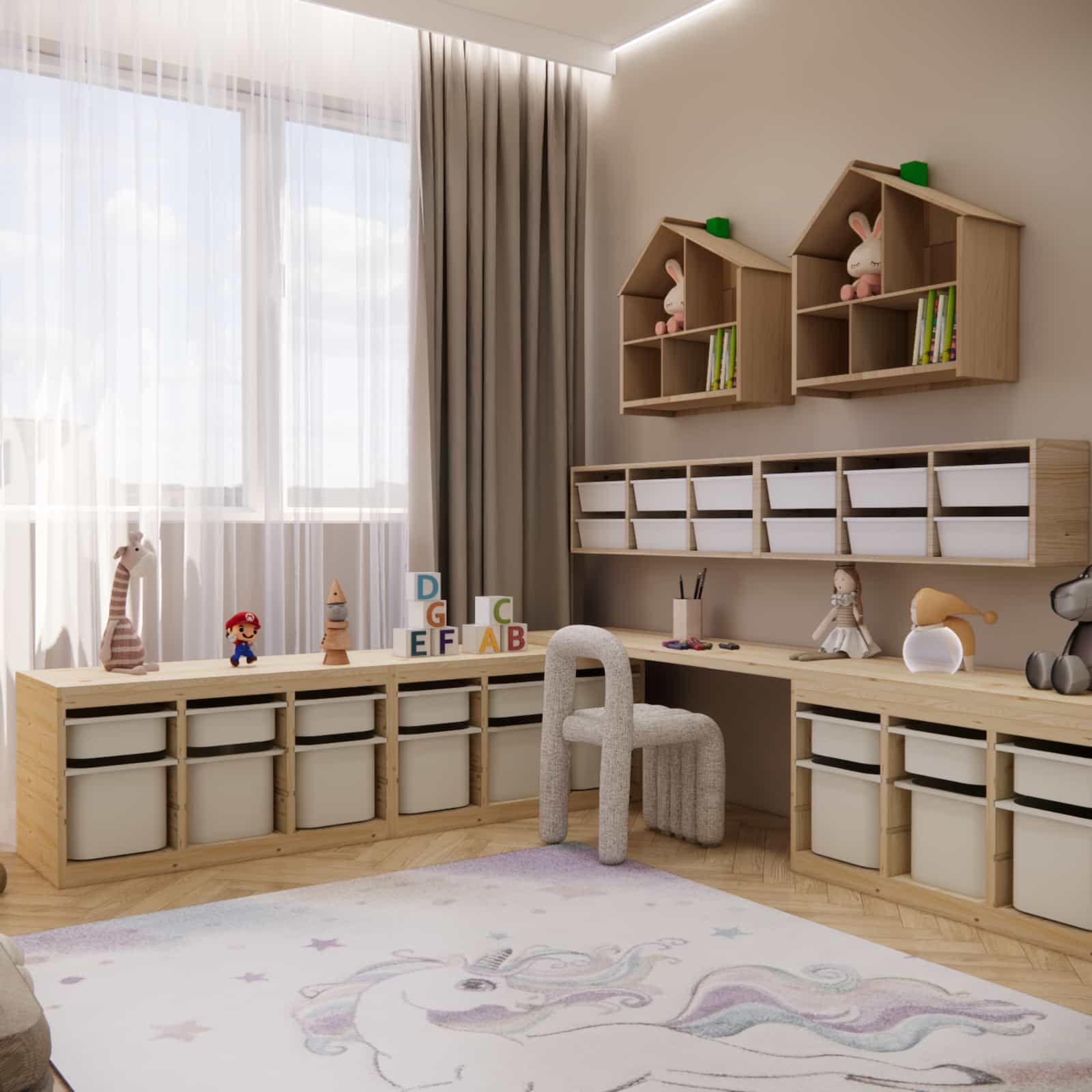
In this project, we divided the room into four basic zones: sleep, play, creativity, and storage. It is a very simple scheme, but that is exactly why it works so well.
The sleeping zone was built around the house bed. It is the calmest part of the interior, visually separated thanks to the canopy and soft textile accents. This arrangement helps the child transition more easily from activity to rest.
The play zone was defined by a soft rug. In a young child’s room, this is very important, because most play takes place on the floor. The rug not only makes the room feel warmer, but also organizes the functional layout and gives the child comfort.
The creative zone includes a small desk and a place for drawing. A four-year-old does not yet need a classic study area, but greatly benefits from having their own place for crayons, paper, and their first creative activities.
The storage zone is based on shelves with bins that the child can use independently. This is both a practical and educational solution, because it teaches organization and putting things back in their place.
This kind of zoning makes the room not only pretty, but above all logical and comfortable.
House bed with a canopy – the heart of the design and the child’s favorite place
It is no coincidence that the house bed for a girl became the central point of the entire project. In children’s rooms, this type of solution combines several functions at once. On the one hand, it provides a comfortable place to sleep; on the other, it stimulates imagination and builds a sense of security.
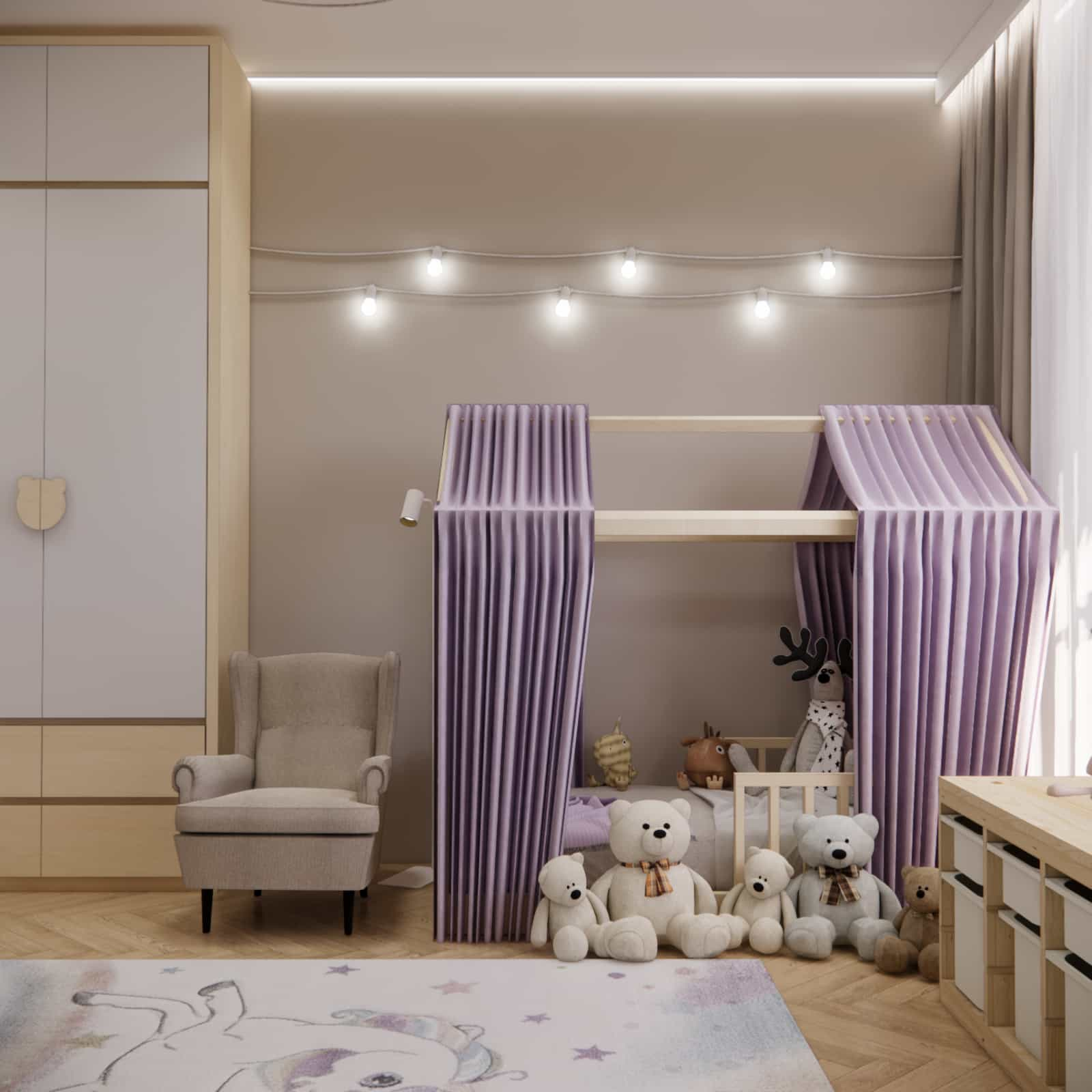
For a small child, a house-shaped bed is much more than just a piece of furniture. It can be a base, a castle, a hideout, a cottage in the woods, or a place where stuffed animals live. That is exactly why it works so well in preschoolers’ rooms. It gives the child a small world of their own without sacrificing functionality.
In this arrangement, the bed was further highlighted with a delicate canopy. This element is not only decorative. It visually warms up the whole composition, softens the shape of the bed, and makes the sleeping zone feel more intimate. In the evening, with the warm light of a lamp, the bed becomes a truly cozy place to unwind.
It is also worth noting that a house bed fits well into an aesthetic that does not age too quickly. It is not a piece of furniture based on a very temporary trend or a specific cartoon character. Thanks to that, the room can be easily updated with accessories, without the need to replace the most important elements of the furnishings.
Unicorn wallpaper – a fairy-tale accent that does not overwhelm the interior
In children’s rooms, it is very easy to overdo the decorative elements. Fairy-tale motifs, intense colors, patterned textiles, and numerous accessories can quickly lead to visual chaos. In this project, we wanted a completely different effect. We wanted the fairy-tale atmosphere to be present, but presented in a subtle and elegant way.
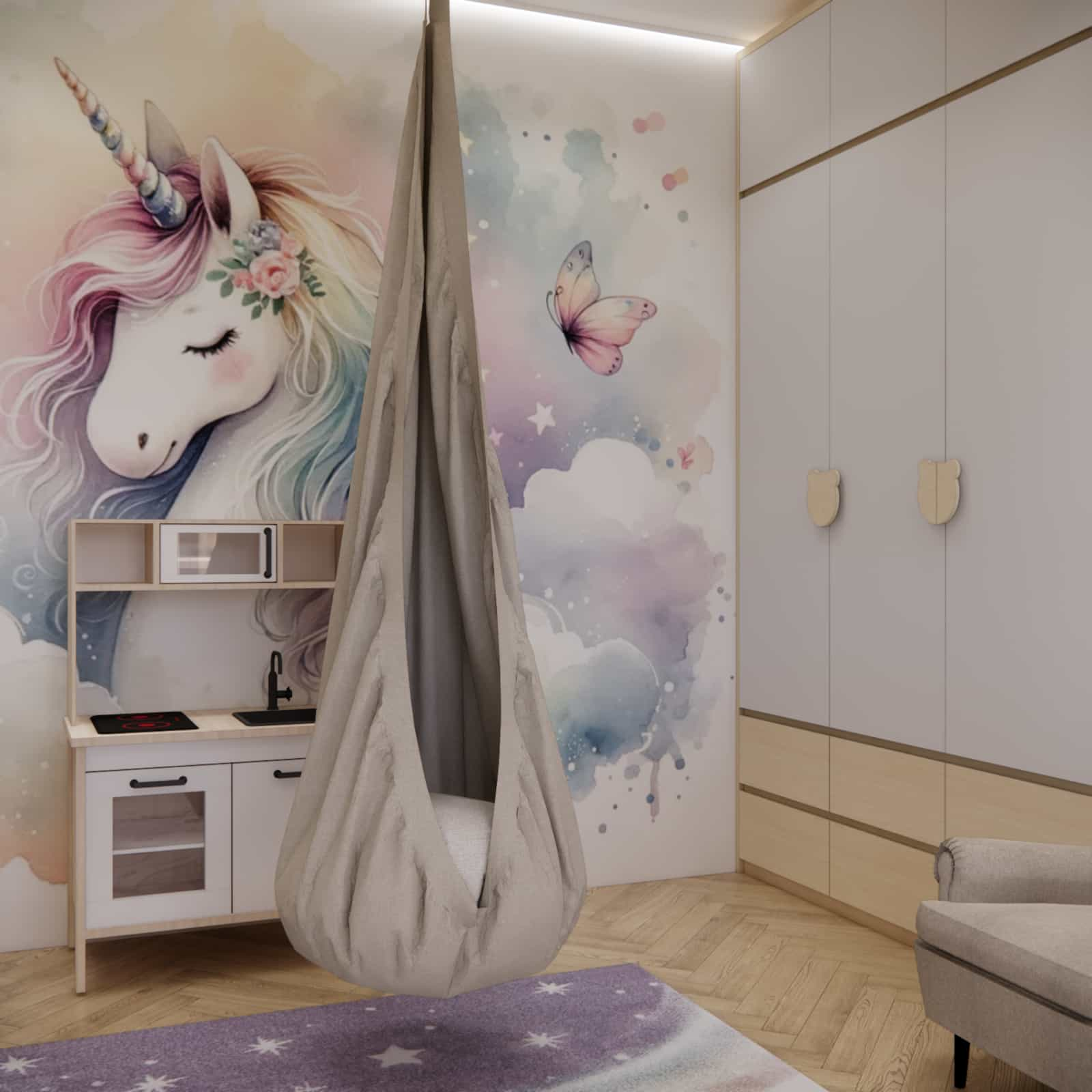
That is why we chose unicorn wallpaper in the child’s room, which serves as the main decorative motif without dominating the entire arrangement. The unicorn, clouds, and soft pastel color transitions create a dreamy, light, and childlike atmosphere while still remaining aesthetically ordered.
This type of wallpaper works best when the rest of the room remains calm. That is exactly why we paired it with light furniture, natural wood, and muted textiles. As a result, the feature wall truly stands out, but does not overwhelm the child with too many visual stimuli.
The unicorn motif is popular for a reason. For many girls aged 3–7, it symbolizes a world of dreams, gentleness, and imagination. However, when used thoughtfully, it can become a very elegant design element rather than just a seasonal decoration.
Pastel color palette – why does it work so well in a 4-year-old girl’s room?
A pastel girl’s room is a solution that has been very popular for years, but its strength does not come only from trends. Pastels genuinely support the character of a children’s interior. They are delicate and non-overwhelming, while also helping to build a friendly and cheerful atmosphere.
In this project, the base consisted of shades of beige, off-white, light wood, and subtle pink and lavender. This palette gives a very good effect for several reasons.
First, it visually brightens the room and makes the interior feel lighter. Second, it works well with children’s toys, which often introduce many colors on their own. Third, it helps build a feeling of warmth and calm, which matters both during playtime and evening winding down.
A pastel arrangement does not have to mean an interior that feels boring or too delicate. The key lies in properly varying textures, materials, and individual accents. In this room, the pastel palette was balanced with wood, shelving details, wall decorations, and the wallpaper pattern. Thanks to that, the whole design looks cohesive rather than flat.
Storage in a child’s room – how to plan order without taking away freedom?
In a well-designed children’s room, storage cannot be accidental. It is one of those areas that determine whether the interior will remain functional after a few weeks of use, and not only on the day the arrangement is finished.
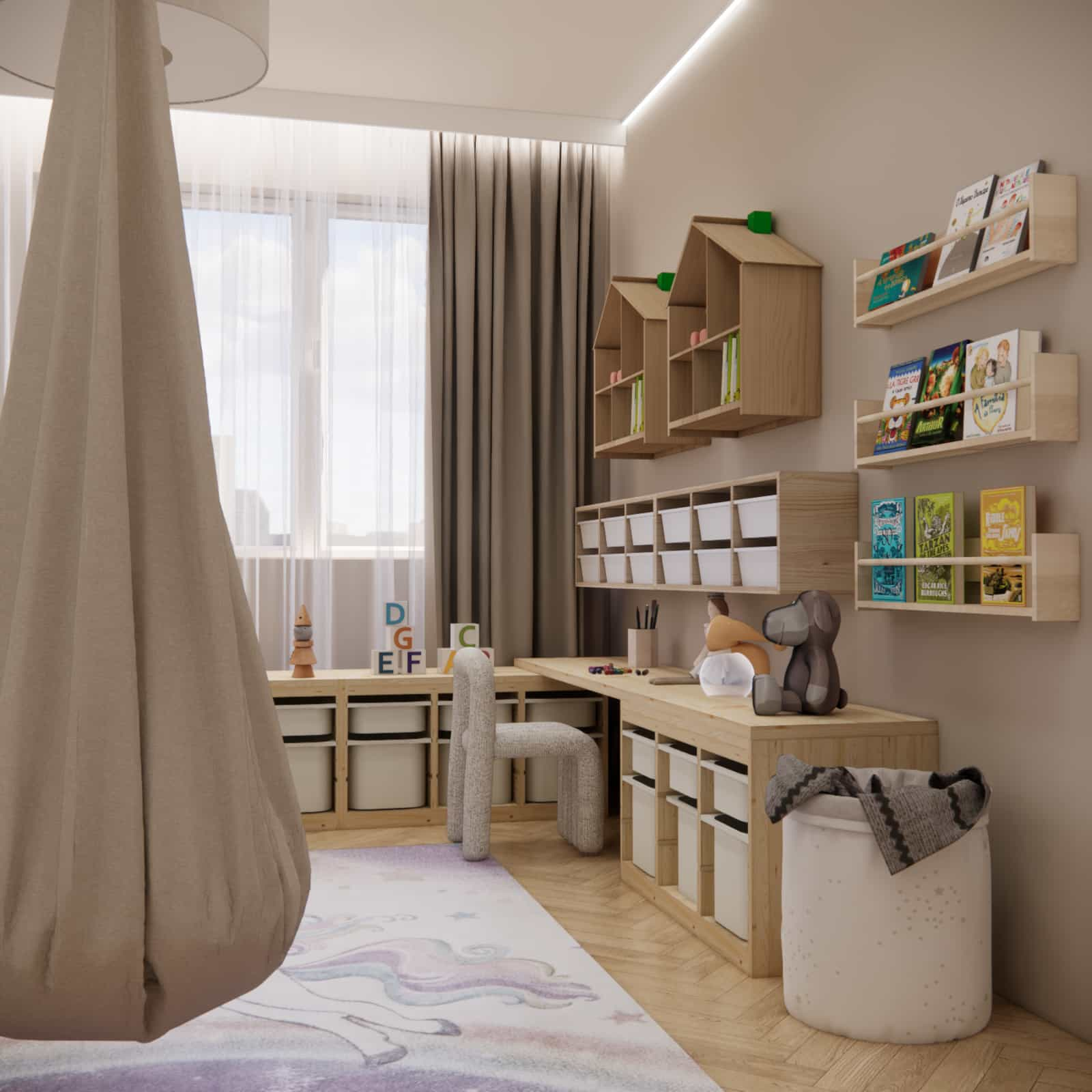
In this project, we used IKEA Trofast shelves with bins. This is a solution we very often use in rooms for small children, because it combines simplicity, capacity, and ease of use. The child can independently reach for toys and put them back in place on their own. This is important, because independence begins with well-designed everyday activities.
The bins also help organize toys by category. Blocks can be stored separately, stuffed animals separately, and art supplies or books in their own sections. This means parents do not have to fight chaos every day, and the child can find their things more easily.
Another big advantage of the Trofast system is its flexibility. You can freely combine bins of different depths, sizes, and colors. This makes it possible to adapt the storage layout to the specific needs of the room.
In this interior, the shelves do not serve only a practical function. Their structure organizes the wall, creates an additional display surface, and visually balances the more decorative elements of the room. As a result, storage does not look like a technical necessity, but like a natural part of the room’s aesthetic.
Wardrobe in a 4-year-old girl’s room – why its role is greater than it seems
In children’s rooms, the most attention is often focused on the bed and play area, while in fact it is the wardrobe that is responsible for everyday order and ease of use. In a project for a 4-year-old, it cannot be too large, overwhelming, or poorly organized inside. At the same time, it must hold clothes, textiles, seasonal accessories, and often also some toys or backup items.
In this interior, the wardrobe was integrated into the overall composition so that it would not dominate the room, but instead serve as a calm background for the more decorative elements. This is important, because large furniture pieces in small or medium-sized children’s rooms can easily disrupt the proportions of the interior.
A well-designed child’s wardrobe should combine a section accessible to parents with elements that the child can reach independently. Lower shelves or easy-access baskets are a great place for everyday clothes, pajamas, or accessories that the child uses regularly.
This kind of layout supports the learning of independence and makes the room truly “child-friendly” not only visually, but functionally as well.
A small desk and a first creative zone – why does a 4-year-old need a place to draw?
Although a four-year-old child does not yet need a classic study zone, it is worth creating a space in the room that encourages drawing, arranging toys, looking at books, and quieter activities. A small desk fulfills this role very well.
In this project, the desk has a light form and does not take up much space, but it gives the child a very important message: “this is your space for creating.” Such a piece of furniture supports everyday rituals and helps organize activities. The child knows where drawing happens, where crayons are kept, and where books should be put away.
It is also a practical solution from the perspective of the future. In the following years, this zone can naturally evolve without requiring a complete rebuild of the room. A change of chair, a new organization of the desktop, or different accessories can be enough to make the space feel more suitable for school-age needs.
That is exactly what a well-designed children’s room is about – solutions that are appropriate for today, but do not close off the possibilities of tomorrow.
The rug and play zone – why is the floor so important in a child’s room?
Adults look at a room mostly from eye level. Children – especially at preschool age – function in a completely different way. They play on the floor, arrange toys there, sit, lie down, build, and create their own little worlds. That is why the floor in a child’s room is not just a background. It is one of the most important functional surfaces.
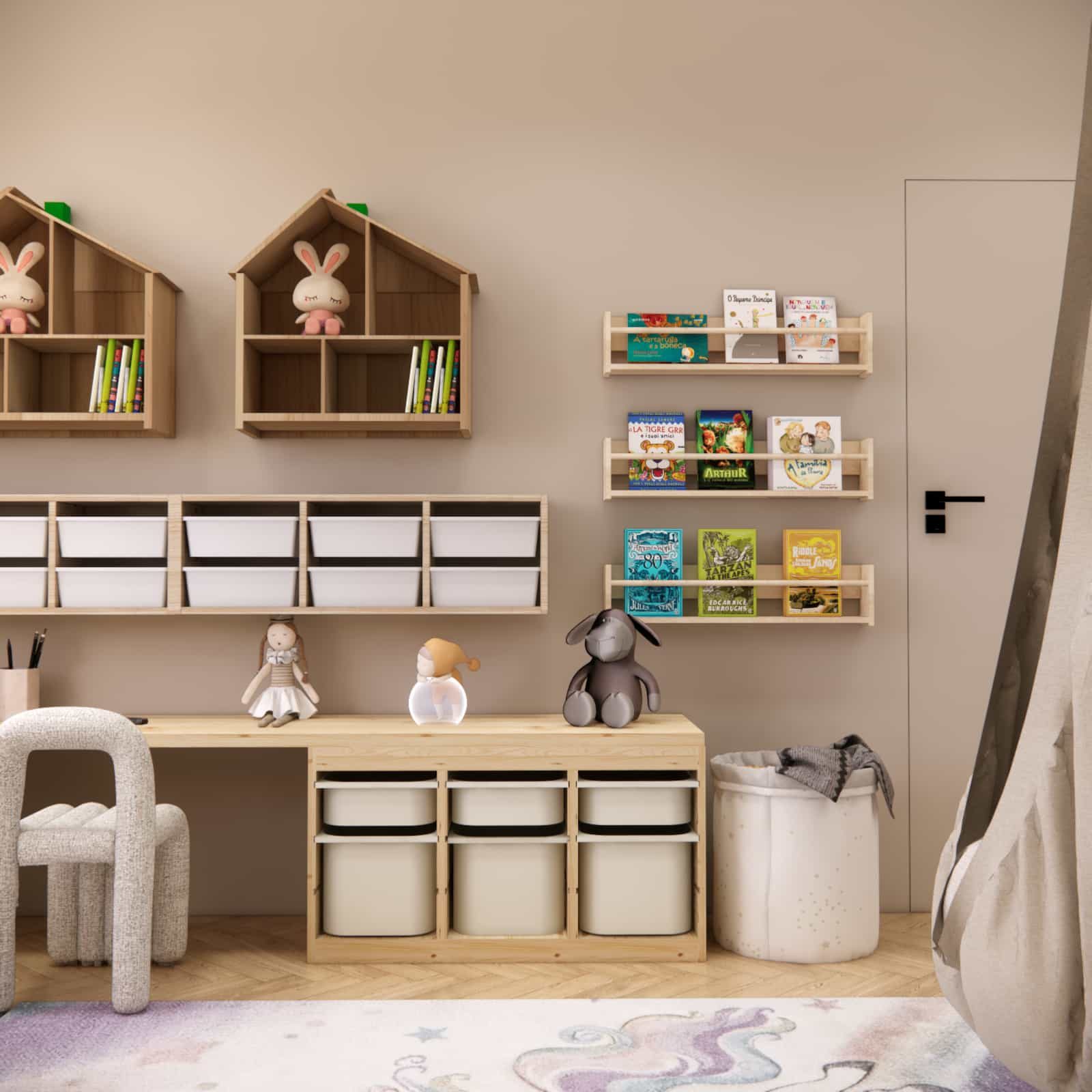
In this project, the soft rug with a unicorn motif plays a very important role. It is not only a decoration and not only an element that makes the room feel warmer. It is a real play zone that organizes the layout of the space and gives the child comfort during everyday activities.
The rug also helps acoustically soften the room and visually ties the arrangement together. In children’s rooms, we like solutions that both decorate and contribute to functionality. That is exactly the effect we achieved here.
It is worth remembering that a rug in a four-year-old’s room should not only be attractive, but also practical. It is best if it has a pleasant texture, is easy to keep clean, and does not introduce overly aggressive patterns that could tire the eyes.
How to create a room that grows with the child?
One of the most important rules we follow when designing children’s interiors is very simple: do not design the room only for “right now.” Children change quickly, their needs evolve, and the interior should allow for natural adaptation.
In this project, we used several solutions that will help preserve the functionality of the room in the years to come. First, the color base is calm and timeless. This means that in two or three years, the decorative theme can be changed without the need for a major renovation.
Second, the furniture has a simple, light form. It is not excessively childish, so it will not look visually outdated after one season. Third, the storage system can be flexibly rearranged as the child’s needs change.
This is very important, because a well-designed child’s room should not require a total revolution at every new stage of development. Sometimes replacing textiles, adding different accessories, or reorganizing the shelves is enough to give the interior a completely new character.
The Fabryka Projektów style – what matters most to us in designing a child’s room?
In our projects, it is not only about the final visual effect. What matters to us is that interiors feel real, useful, and well grounded in everyday life. In the case of children’s rooms, this is especially important, because here every design decision affects not only the look, but also the rhythm of everyday family life.
When designing this room for a 4-year-old girl, we combined three key principles. The first was functionality – a layout that truly makes everyday life easier. The second was coziness – soft, calm, child-friendly, but not overly sweet. The third was aesthetics based on details that build atmosphere without excess chaos.
This is exactly the way of thinking that stands behind our design approach. If you want to see how we work on projects like this and what a professionally prepared online children’s room design looks like, on the service page we show the scope of the project and the way we combine visualizations with a practical approach to everyday life.
This project shows that a room for a 4-year-old girl can be at the same time fairy-tale-like, delicate, and highly functional. The house bed with a canopy builds a sense of safety and coziness. The unicorn wallpaper gives the interior a dreamy atmosphere. IKEA Trofast shelves with bins keep toys organized and support independence. The small desk creates a place for creative activities, while the rug defines the central play zone.
Most importantly, however, all of these elements do not work separately. Together, they create a cohesive space that responds to the real needs of both the child and the parents. That is why a children’s room design should be treated as something more than a choice of furniture and colors. It is a thoughtful composition of everyday life, development, and childhood imagination.
If you are planning a similar arrangement and looking for proven solutions, inspiration, or design support, also take a look at our room designs for girls aged 3–7. It is a great place to compare different ideas and find the direction best suited to your interior.
FAQ – frequently asked questions about a room for a 4-year-old girl
How to design a room for a 4-year-old girl?
The best place to start is by dividing the interior into zones: sleep, play, storage, and creativity. At this age, a child needs a room that supports daily activities, not just one that looks good. Light colors, a soft rug, a comfortable bed, easily accessible toy storage, and a small place for drawing all work very well.
What colors work best in a room for a 4-year-old girl?
Pastel and light colors usually work best, such as beige, off-white, soft pink, lavender, or subtle shades of apricot. This palette calms the interior, reflects light well, and creates a friendly background for furniture, toys, and decorations.
Is a house bed a good choice for a child’s room?
Yes, a house bed is a very good solution for a preschooler’s room. It serves as a place to sleep, but also builds the atmosphere of the room and stimulates imagination. For a child, it becomes part of play while also offering a sense of security and coziness.
Does a canopy over the bed make sense, or is it just decoration?
A canopy certainly decorates the room, but it also has a practical function. It visually defines the sleeping area, softens the arrangement, and helps create a more intimate atmosphere. In many children’s rooms, such a detail has a positive effect on evening relaxation.
How should toys be stored in a room for a 4-year-old?
Low shelves with bins that the child can use independently work best. A good example is systems like IKEA Trofast. They make it easier to keep order, divide toys into categories, and teach the child to put things away.
Does a 4-year-old child need a desk?
A classic study desk is not yet necessary, but it is worth creating a small creative area with a tabletop for drawing, coloring, and looking through books. Such a space supports manual development and helps organize the child’s everyday activities.
What wallpaper is best for a girl’s room?
It is best to choose wallpaper that fits the childlike character of the room but is not too visually aggressive. Watercolor motifs, pastels, delicate botanical patterns, clouds, stars, or unicorns work very well. The important thing is that the wallpaper matches the rest of the arrangement and does not create chaos.
How should you plan a wardrobe in a small child’s room?
The wardrobe should combine space for clothes, textiles, and seasonal items, but it is also worth including elements accessible to the child. Low shelves, baskets, or drawers help teach independence and make it easier for the child to navigate their own space.
How do you design a room so that it grows with the child?
The best approach is to choose a calm, neutral color base and furniture with simple, timeless forms. Then, as the child grows, you can change the accessories, textiles, decorations, and organization of the room without the need for a complete redesign.
Is it worth ordering a professional children’s room design?
Yes, especially if you want to combine aesthetics with a practical layout and make the most of the available space. A professional design helps avoid mistakes, plan functions well, and see the final effect before implementation. If you want to see what such a process looks like, take a look at our children’s room design prepared online.